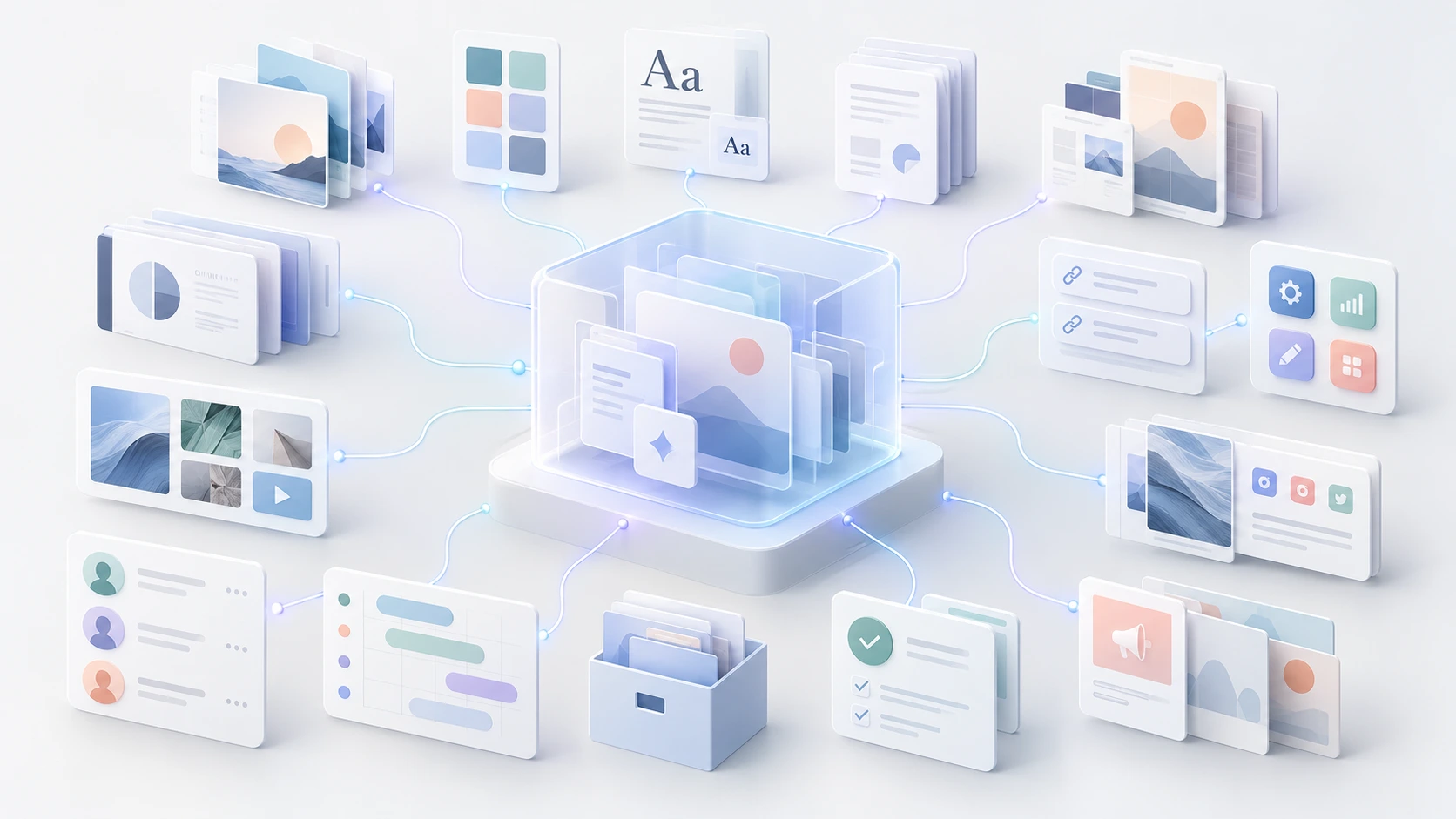
What Is a Centralized Workspace?

Your files are in Google Drive. Projects are in Asana. Conversations are in Slack. Documentation is in Notion. Customer information is in a CRM. Important decisions are buried somewhere in email.
Individually, these tools are useful.
Together, they can create a surprisingly complicated way to work.
As organizations add more people, projects, clients, applications, and information, the challenge is no longer simply having the right tools. The challenge is knowing where everything belongs, where to find it, and how everything connects.
That is where a centralized digital workspace comes in.
A centralized digital workspace gives an organization a single, organized environment for accessing the information, resources, tools, and workflows it needs to get work done.
It does not necessarily mean replacing every application your team uses. Instead, it means creating a central place from which work can be understood, accessed, organized, and connected.
“A digital HQ is a single, virtual space to connect your people, tools, customers and partners.” — Slack
In this guide, we'll explore what a centralized digital workspace is, why businesses are adopting them, what one should contain, how it differs from traditional productivity software, and how your organization can start building one.
What Is a Centralized Digital Workspace?
A centralized digital workspace is a digital environment that brings an organization's essential work, information, resources, and tools together into one connected place.
Think of it as the digital home of your organization.
Instead of employees having to remember:
-
Which application contains a particular file
-
Which document has the latest version
-
Where a project is being tracked
-
Where the brand guidelines are stored
-
Which Slack conversation contains an important decision
-
Who owns a particular task
-
Where a particular link or resource was saved
…the workspace provides a central point of access.
The goal isn't necessarily to put every piece of data into one database.
The goal is to make the organization's digital environment feel like one connected system rather than a collection of disconnected tools.
This distinction is important.
Centralized does not mean “one app for everything”
A common misunderstanding is that centralization means replacing every tool your business uses with a single platform.
That's rarely practical.
A design team may still need Figma. Developers may still need GitHub. Marketing may still use HubSpot. Finance may use accounting software. Teams may communicate through Slack or Microsoft Teams.
A centralized workspace acts as the layer that brings context around those tools together.
For example:
Marketing campaign
→ Campaign overview
→ Strategy document
→ Project tasks
→ Brand assets
→ Design files
→ Approval status
→ Performance data
→ Related conversations
→ Important links
The underlying resources may live in different applications, but employees have a clear place to find and understand them.
Why Do Organizations Need a Centralized Digital Workspace?
Modern work has created a paradox.
Businesses have more powerful software than ever, yet employees can spend considerable time simply trying to find information.
Microsoft's 2025 Work Trend Index reported that employees are interrupted by a meeting, email, or notification approximately every two minutes during the workday.
Microsoft's related research also reported that employees receive, on average, more than 100 emails and 150 Microsoft Teams messages per day.
The problem isn't necessarily that organizations have too little technology.
It is that they often have too much disconnected technology.
Every additional tool can create another:
-
Login
-
Notification stream
-
Search system
-
File structure
-
Permission model
-
Workflow
-
Source of truth
Eventually, employees start spending time managing the work environment instead of doing the work itself.
A centralized workspace attempts to reverse that.
The Problem With a Disconnected Digital Workplace
Imagine a company called Northstar Studio.
They have:
-
Google Drive for documents
-
Slack for communication
-
Notion for internal documentation
-
Asana for projects
-
Figma for design
-
Dropbox for client files
-
Gmail for external communication
-
HubSpot for leads
None of these tools are necessarily bad.
In fact, each may be excellent at its specific purpose.
The problem appears when someone asks:
“Where can I find everything related to the Acme project?”
An employee might need to check five or six different applications to answer a simple question.
They may find the project plan in Asana, designs in Figma, client files in Dropbox, meeting notes in Notion, and the latest decision in Slack.
The work exists.
But the context is scattered.
That creates what we can call the search tax.
Every time someone searches for information, switches applications, asks a colleague where something is, or recreates something that already exists, the organization pays a small productivity cost.
Multiply that across dozens or hundreds of employees and thousands of interactions, and the cost becomes significant.
Centralized Workspace vs. Traditional File Storage
A centralized digital workspace is more than a shared folder.
Traditional file storage answers:
“Where is the file?”
A modern workspace should help answer:
“What is this, why does it matter, who owns it, what is related to it, and where does the work go from here?”
For example, a folder named:
Client → Acme → 2026 → Marketing
is useful.
But a workspace could provide:
Acme
Client: Acme Corporation
Account owner: Sarah
Project: Q4 Product Launch
Status: In progress
Deadline: November 18
Project resources
-
Strategy
-
Brand guidelines
-
Campaign brief
-
Creative files
-
Content calendar
-
Meeting notes
-
Approval documents
Connected tools
-
Figma
-
Asana
-
Google Drive
-
Slack
This creates context, not just storage.
The Core Components of a Centralized Digital Workspace
There is no single formula for what a centralized workspace must contain. The right structure depends on the organization.
However, successful workspaces commonly bring together several core components.
1. Information and Knowledge
Your organization's knowledge should be easy to find.
This might include:
-
Company policies
-
SOPs
-
Internal guides
-
Meeting notes
-
Research
-
Product documentation
-
Brand guidelines
-
Training materials
-
FAQs
-
Strategic documents
The important principle is that knowledge should have a clear home.
Notion, for example, positions its wiki as a centralized place for organizational knowledge, with search, connected pages, verification, teamspaces, and integrations.
2. Projects and Tasks
Information is valuable, but organizations also need somewhere to turn information into action.
A workspace can connect:
Goal → Project → Tasks → Owner → Deadline → Progress
Tools such as Asana focus heavily on connecting tasks, projects, ownership, deadlines, and team visibility.
This makes it easier to understand not only what exists, but what needs to happen next.
3. Files and Assets
Organizations manage enormous amounts of digital content.
Examples include:
-
Documents
-
Images
-
Videos
-
Presentations
-
Spreadsheets
-
Brand assets
-
Contracts
-
Templates
-
Product files
A centralized workspace can provide a consistent way to access these resources, even when the underlying files remain in specialized services.
4. Communication
Communication is another major part of modern work.
A centralized workspace doesn't necessarily need to replace Slack, Teams, or email.
Instead, it can provide the context around communication.
For example:
Product Launch
→ Launch plan
→ Project tasks
→ Latest decision
→ Relevant conversation
→ Creative files
→ Owner
→ Timeline
This is more useful than having the discussion exist in isolation.
5. People and Ownership
Information becomes much more useful when you know who is responsible for it.
A mature workspace should make it easy to understand:
-
Who owns a project
-
Who manages a client
-
Who maintains a document
-
Who approves a request
-
Who belongs to a team
-
Who should be contacted about an issue
This creates organizational visibility.
6. Integrations
Centralization doesn't require every application to be rebuilt inside your workspace.
Integrations are what make centralization practical.
For example, an organization might connect:
Google Drive + Slack + Figma + Asana + CRM + Calendar
so employees can access the right information without constantly jumping between systems.
Atlassian's current approach is a good example of this direction: its platform connects data and context across Atlassian and third-party applications, including collaboration and cross-product search capabilities.
The Benefits of a Centralized Digital Workspace
1. Less Time Searching
One of the simplest benefits is also one of the most valuable:
people spend less time looking for things.
Instead of asking:
“Where is that document?”
or:
“Which version are we using?”
employees have a predictable place to start.
2. Better Context
A file by itself tells you very little.
A file connected to its project, owner, deadline, related documents, and decisions becomes much more useful.
Centralization allows organizations to move from isolated information to connected information.
3. Fewer Context Switches
Context switching happens when someone repeatedly moves between applications, tasks, conversations, and information sources.
For example:
Slack → Drive → Asana → Gmail → Figma → Slack → Notion
The work itself might be simple.
The environment makes it complicated.
A connected workspace can reduce unnecessary movement by bringing relevant information and links together.
Notion describes connected workspaces in a similar way, emphasizing the ability to bring projects, documents, databases, notes, and content from external tools into a connected environment.
4. Better Onboarding
New employees face one of the biggest information challenges in an organization.
They need to learn:
Where do we work?
Where are our documents?
How do we manage projects?
Where are the brand guidelines?
Who handles what?
Where can I find previous decisions?
A centralized workspace gives new employees an organized starting point rather than sending them a collection of links.
This can dramatically improve the onboarding experience.
Notion's organizational guidance, for example, specifically focuses on bringing teams, documents, and projects together as part of a consolidated work experience.
5. More Consistent Processes
Centralization also makes it easier to standardize how work happens.
For example, every new client could automatically have the same structure:
Client Overview
↓
Contacts
↓
Projects
↓
Documents
↓
Brand Assets
↓
Tasks
↓
Reports
This reduces organizational randomness.
6. Greater Visibility
Leaders don't necessarily need to inspect every task.
They need to understand the bigger picture.
A centralized environment can make it easier to see:
-
What is happening
-
What is blocked
-
Who owns it
-
What is overdue
-
Which projects are active
-
Which resources are being used
-
Where important information lives
That visibility helps organizations make better decisions.
What Does a Centralized Digital Workspace Look Like?
A useful way to visualize it is as a hierarchy.
Organization
Your company
↓
Teams
Marketing
Sales
Product
Design
Operations
↓
Workspaces / Areas
Projects
Clients
Departments
Brands
Processes
↓
Resources
Documents
Tasks
Files
People
Links
Conversations
Knowledge
↓
External Tools
Drive
Slack
Figma
Asana
CRM
Analytics
Calendar
GitHub
The workspace becomes the connective layer between people, information, and applications.
What Is the Difference Between a Digital Workspace and a Digital HQ?
You may also hear the terms:
Digital workspace
Digital workplace
Digital HQ
Connected workspace
These concepts overlap, but they can emphasize different things.
A digital workplace generally refers to the overall digital environment employees use to work.
A digital workspace is often a more practical, user-facing environment where work and information are organized.
A digital HQ puts stronger emphasis on the idea that the digital environment becomes the central place where an organization operates.
Slack, for example, describes a digital HQ as a virtual space connecting people, tools, customers, and partners.
The terminology may vary.
The underlying idea is similar:
Your organization needs a digital place where work makes sense.
Centralization Doesn't Mean Getting Rid of Every Tool
This is one of the most important principles.
Your goal shouldn't be:
“Let's replace our entire software stack.”
Your goal should be:
“Let's make our software stack easier to navigate.”
A design team can continue using Figma.
A developer can continue using GitHub.
A sales team can continue using a CRM.
A company can continue using Google Workspace or Microsoft 365.
The centralized workspace should help employees understand how those tools fit together.
In other words:
Specialized tools do the work.
The centralized workspace provides the context.
Examples of Centralized Workspace Tools
Different organizations will need different approaches.
Here are some tools worth exploring.
Notion
Notion combines documents, wikis, projects, databases, and connected information within a single workspace. It is particularly useful for knowledge management, documentation, team hubs, and lightweight project management.
Microsoft 365
Microsoft's ecosystem can act as the foundation for organizations already using products such as Teams, SharePoint, OneDrive, Outlook, Word, Excel, and other Microsoft services.
Google Workspace
Google Workspace is a strong option for organizations built around Gmail, Drive, Docs, Sheets, Slides, Meet, and other Google productivity tools.
Asana
Asana is particularly useful when the main challenge is organizing projects, tasks, ownership, deadlines, and workflows.
Slack
Slack approaches the idea from the communication side, describing the digital HQ as a place where people, tools, customers, and partners can connect.
Atlassian
Atlassian is another useful example, particularly for organizations that need strong connections between project delivery, documentation, collaboration, and software development. Its Teamwork Collection brings together Jira, Confluence, Loom, and Rovo.
The Best Workspace Isn't Necessarily the One With the Most Features
It's easy to compare software by counting features.
That can be a mistake.
A workspace with 100 features can still produce a poor experience if employees don't know where to go.
A good centralized workspace should answer five questions quickly:
1. Where do I start?
There should be a clear home.
2. Where is the information I need?
Search and navigation should be intuitive.
3. What is happening?
Projects, updates, and activity should be visible.
4. Who is responsible?
People, ownership, and permissions should be clear.
5. What should I do next?
The workspace should help turn information into action.
The best workspace isn't the one that stores the most information.
It's the one that makes the right information easy to find at the right moment.
How to Build a Centralized Digital Workspace
You don't need to centralize everything on day one.
A better approach is to start with the most important information flows.
Step 1: Map Your Existing Tools
Write down every tool your organization currently uses.
For example:
Purpose
Tool
Communication
Slack
Documents
Google Drive
Tasks
Asana
Design
Figma
CRM
HubSpot
Meetings
Google Meet
Knowledge
Notion
Development
GitHub
Then ask:
Where does information move between these systems?
Those connections are often where the biggest problems exist.
Step 2: Identify Your Sources of Truth
For every type of information, decide where the authoritative version lives.
For example:
Projects → Asana
Design files → Figma
Company documents → Google Drive
Internal knowledge → Notion
Source code → GitHub
The centralized workspace can then point employees toward those sources rather than creating duplicate copies everywhere.
Step 3: Create a Clear Organizational Structure
Don't simply create dozens of folders.
Create a structure that mirrors how your organization actually works.
For example:
Company
→ Departments
→ Clients
→ Projects
→ Products
→ Resources
→ Knowledge
→ Important links
The simpler the structure, the easier it is to maintain.
Step 4: Connect Your Tools
Use integrations, embeds, linked resources, APIs, and automation where appropriate.
The objective is to reduce unnecessary switching.
Atlassian's collaboration model, for example, emphasizes connected experiences and cross-product search so users can obtain context across tools in fewer places.
Step 5: Establish Ownership
Every important resource should ideally have someone responsible for maintaining it.
A centralized workspace without ownership can eventually become a centralized mess.
Ask:
Who owns this?
Who updates it?
When was it last reviewed?
Is this still accurate?
Step 6: Build Search Into the Experience
As your organization grows, navigation alone becomes insufficient.
Search becomes critical.
But great search isn't just about finding filenames.
It should ideally help people discover:
-
Documents
-
Projects
-
People
-
Clients
-
Tasks
-
Decisions
-
Resources
-
Connected information
This is one reason search is becoming increasingly important in modern workplace platforms.
Common Mistakes When Centralizing Work
Centralization sounds simple, but it can fail when implemented poorly.
Mistake 1: Moving Everything Into One Place
Centralization doesn't mean duplicating everything.
Duplicate information creates version conflicts.
Instead, connect to the original source whenever possible.
Mistake 2: Creating Too Much Structure
A workspace with hundreds of categories can become just as difficult to navigate as a scattered system.
Start simple.
Mistake 3: Ignoring Existing Tools
Your team already has established workflows.
Trying to replace everything immediately often creates resistance.
Connect first. Replace only where necessary.
Mistake 4: Forgetting Governance
Someone needs to maintain the workspace.
Without ownership, information becomes outdated.
Mistake 5: Optimizing for Storage Instead of Use
A workspace shouldn't become a digital warehouse.
Its purpose is to help people work.
Centralized Digital Workspace and the Rise of AI
The importance of centralization becomes even greater as AI becomes part of everyday work.
Why?
Because AI is only as useful as the context it can access.
Imagine asking an AI assistant:
“What is the current status of the Acme project?”
If project information is scattered across six disconnected systems, producing a reliable answer becomes much harder.
Now imagine the assistant can access:
-
Project information
-
Tasks
-
Documents
-
Decisions
-
People
-
Deadlines
-
Related conversations
-
Customer information
The organization has effectively created a context layer for AI.
This is part of a broader movement toward connected work systems. Atlassian, for example, now describes its platform as connecting curated data, context, and goals across applications, while its Teamwork Collection combines work management, knowledge management, async communication, and AI.
The future of the workspace may therefore be less about where information is stored and more about how intelligently that information can be connected and used.
A Simple Test: Is Your Organization Centralized?
Ask your team these questions:
“Where is our latest company presentation?”
“Where are the brand guidelines?”
“What projects are currently active?”
“Who owns this client?”
“Where can I find the process for doing this?”
“What was the decision we made last month?”
“Where do I find everything related to Project X?”
If different people give you different answers, your organization probably has a centralization problem.
And that problem usually becomes more expensive as the company grows.
A Centralized Workspace Is About Clarity
At its core, centralization isn't really a technology problem.
It's a clarity problem.
Your employees should know:
where to go, what to look for, what is current, who owns it, and what happens next.
The technology simply makes that possible at scale.
A centralized digital workspace can help organizations move from:
Scattered → Connected
Searching → Finding
Duplicating → Linking
Guessing → Knowing
Switching → Working
And that shift can have a surprisingly large effect on how a company operates.
The Future of Work May Have a Home
Organizations once had a physical headquarters where people knew where to go to find colleagues, documents, conversations, resources, and equipment.
As work becomes increasingly digital, that concept is changing.
The office is no longer the only place where work happens.
Your company's digital environment is becoming just as important.
The future may not be about having fewer tools.
It may be about making those tools feel like one connected organization.
That's the real promise of a centralized digital workspace.
How Awolan Fits Into This Idea
At Awolan, we believe organizations shouldn't have to search through dozens of disconnected places just to understand their own work.
Awolan is being built around a simple idea:
Give your organization one place to organize the things that matter.
Instead of treating your company as a collection of disconnected tools, information, teams, and resources, Awolan helps create a more connected workspace around them.
The goal isn't simply to give businesses another application.
It's to make the digital side of an organization feel more like one place.
Less searching.
Less confusion.
More context.
More time spent doing meaningful work.
One place for your organization to work.
Recommended Resources
Want to explore the idea further? These are useful places to start.
Connected Workspaces
Notion's guide to building a connected workspace explains how teams can bring knowledge, documentation, projects, meetings, and external tools together.
Read Notion's Connected Workspace Guide
Digital HQ
Slack's explanation of the digital HQ is useful for understanding how communication, tools, and people can converge in a digital-first organization.
Teamwork & Connected Systems
Atlassian's Teamwork Collection provides a useful example of how project management, documentation, asynchronous communication, and AI can operate as a connected system.
Explore Atlassian's Teamwork Collection
Work Trend Research
Microsoft's Work Trend Index is worth following for research into how technology, interruptions, AI, and organizational workflows are changing modern work.
Explore Microsoft's Work Trend Index
Final Takeaway
A centralized digital workspace isn't simply a place to store files.
It is a connected environment where people can find information, understand context, collaborate, and move work forward.
The objective isn't to eliminate every tool.
It is to eliminate the feeling that your organization is spread across dozens of unrelated places.
As businesses become more distributed, more digital, and more dependent on information, having a clear digital home is becoming less of a luxury and more of an operational advantage.
The future workplace may not be a building. It may be the place where everything your organization needs comes together.