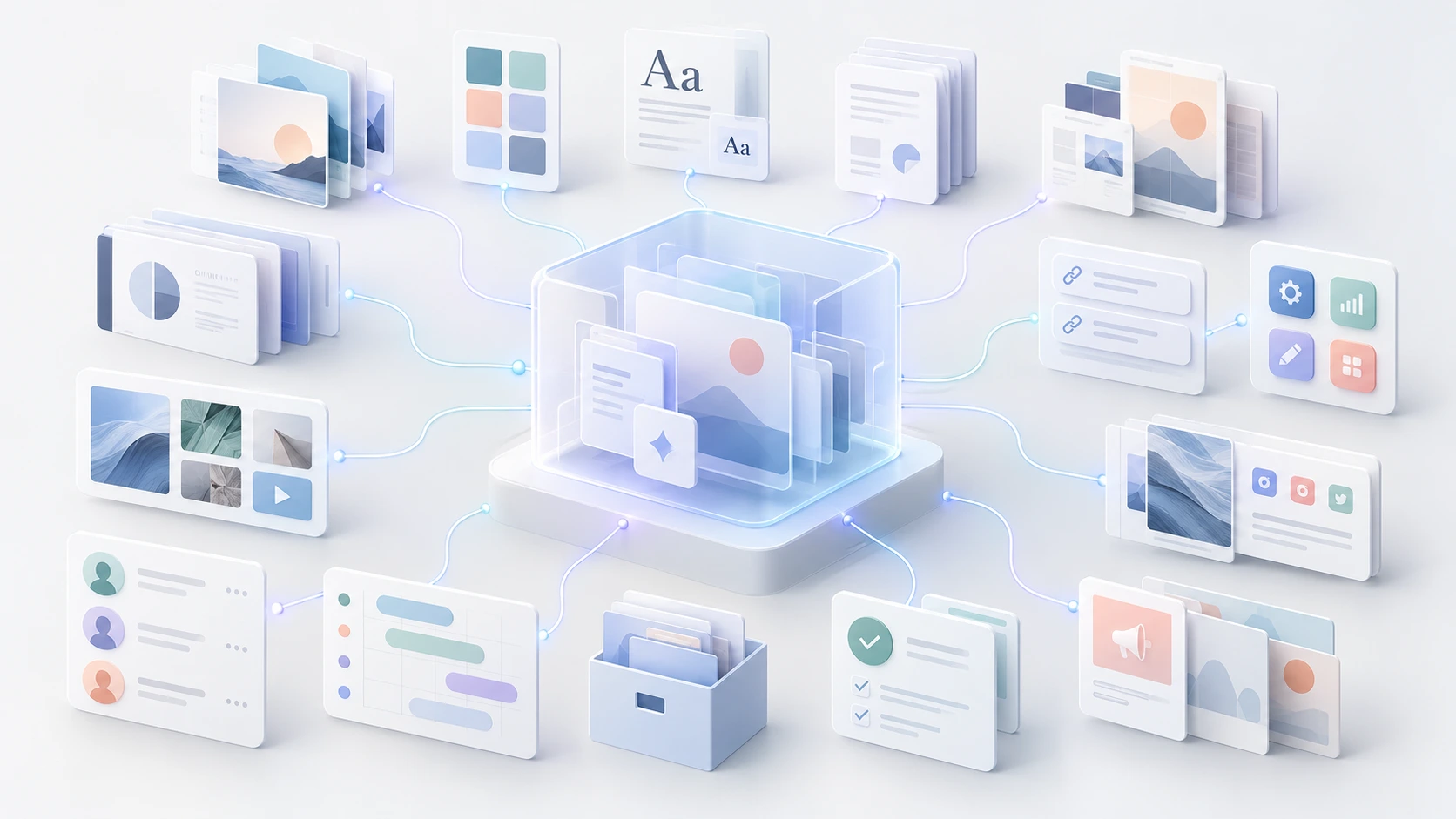
The Benefits of Having One Place for Your Business Information

As businesses grow, so does the amount of information they need to manage.
Documents live in Google Drive. Projects are tracked in Asana. Conversations happen in Slack. Files are shared through email. Important links are saved in bookmarks. Client information may be spread across several different platforms.
Each tool can be useful on its own.
The problem starts when your team has to search through all of them just to find something simple.
What if your business had one place to start?
A centralized workspace can bring important business information together, making it easier for teams and agencies to find, manage, and use the information they need.
Here are some of the biggest benefits.
1. Spend Less Time Searching
One of the biggest advantages of having a central place for business information is simply saving time.
Think about a team member trying to find a client's latest brand guidelines.
They might check a cloud storage folder, search Slack, look through an email thread, or ask another employee.
A centralized workspace gives them a predictable starting point.
Instead of asking:
“Where is it?”
they can ask:
“Where is it in our workspace?”
That small difference can remove a lot of unnecessary searching.
2. Keep Information Organized
When information is spread across different systems, there is often no consistent structure.
One client might have files organized by year. Another by project. Another by file type.
A centralized workspace allows teams to create a more consistent system.
For agencies managing multiple clients, that could mean giving every client brand a familiar structure:
Brand Assets → Documents → Guidelines → Projects → Links → Tools
Once the structure is established, managing new clients becomes much easier.
3. Give Your Team Better Context
A file by itself doesn't always tell you much.
A presentation could belong to a campaign, a client, or an internal project.
When information is organized around the work it belongs to, the context becomes clearer.
For example, instead of simply finding a logo file, your team can find the logo alongside:
-
Brand guidelines
-
Approved colors
-
Typography
-
Client documents
-
Important links
-
Related tools
This makes information more useful, not just more accessible.
4. Reduce Duplicate Work
Scattered information often leads to duplicated work.
Someone can't find an existing document, so they create a new one.
A designer can't find an approved asset, so they recreate it.
A team member doesn't know whether a resource already exists, so they start from scratch.
When information is easier to discover, teams can reuse what they already have.
Find it before you recreate it.
5. Improve Collaboration
Teams work better when everyone can access the same information.
Instead of information being owned by one person or hidden inside an individual folder, important resources can become accessible to the people who need them.
This is especially valuable for agencies.
Account managers, designers, marketers, freelancers, and other team members can all work from the same client information without constantly requesting files from one another.
6. Make Employee Onboarding Easier
New employees have a lot to learn.
They need to understand:
Where do we store files?
Where are our processes?
Which tools do we use?
Where are the client assets?
Who manages each account?
A centralized workspace can give new employees a clear starting point.
Instead of sending them a long list of scattered links, you can point them toward one organized environment.
7. Reduce Knowledge Loss
Important business knowledge shouldn't exist only in someone's memory.
When information is stored across personal folders, emails, and conversations, it can become difficult for the rest of the organization to access.
A centralized workspace helps preserve important information so that it remains available even when people change roles or leave the company.
The goal is simple:
Knowledge should belong to the organization, not just the individual.
8. Make Client Management Easier
For agencies, having one place for each client can be particularly valuable.
A client isn't just a collection of files.
The agency may also need to manage:
-
Brand assets
-
Guidelines
-
Documents
-
Websites
-
Social profiles
-
Marketing tools
-
Project resources
-
Important contacts
Bringing these resources together creates a more complete view of the client brand.
Instead of jumping between different systems, the team can start with the client and find what they need from there.
9. Create a More Consistent Way of Working
A centralized system also helps standardize how teams work.
When every client or project follows a similar structure, people spend less time figuring out where things belong.
That consistency becomes more valuable as your organization grows.
A system that works for three clients should ideally still make sense when you're managing thirty.
10. Build a Digital Home for Your Business
Perhaps the biggest benefit is the simplest:
Your team has a place to start.
Your business may still use Google Drive, Slack, Asana, Figma, Dropbox, CRM platforms, and dozens of other specialized tools.
You don't necessarily need to replace them.
You need a clear environment that connects the information around them.
Think of it as your business's digital home.
A place where your team can understand what the organization has, where things belong, and where to go next.
One Place Doesn't Mean One Tool
Centralizing business information doesn't mean putting everything into one application.
Specialized tools exist for a reason.
Your design team may need Figma. Your sales team may need a CRM. Your project managers may use Asana.
The goal is not to eliminate those tools.
The goal is to make the experience of using them less fragmented.
Your team shouldn't need to understand your entire software stack just to find a client document.
How Awolan Helps
Awolan is designed for teams and agencies managing client brands.
It gives each brand an organized workspace where teams can manage and access brand assets, documents, links, and digital tools without relying on scattered folders and disconnected resources.
Instead of searching across different places, your team can start with the client brand and find the information connected to it.
Less searching. Less confusion. More context.
One Place for Everything Your Team Needs
Your business will continue to generate more information as it grows.
The question is whether that information becomes harder to manage—or easier to access.
A centralized workspace can help turn scattered business information into something your team can actually use.
Every client. Every brand. One place.