10 Ways to Improve Team Productivity Without Hiring More People

When a team feels overwhelmed, the first solution is often to hire more people.
But hiring isn't always the answer.
Sometimes the problem isn't that your team is too small. It's that too much time is being lost to searching, repetitive work, unnecessary meetings, unclear processes, and disconnected information.
Before adding more people to your team, look at how your existing team works.
Small improvements to the way information and work are organized can create significant gains in productivity.
Here are 10 practical ways to improve team productivity without hiring more people.
1. Reduce the Time Spent Searching for Information
One of the easiest productivity problems to overlook is searching.
Employees might spend time looking for:
-
Client files
-
Brand assets
-
Project documents
-
Meeting notes
-
Previous work
-
Important links
-
Internal processes
The problem becomes particularly noticeable in agencies managing multiple clients.
Instead of having information scattered across Google Drive, Slack, email, Dropbox, and other tools, create a clear structure for where important information belongs.
Your team should know exactly where to start looking.
Less searching means more time working.
2. Create Repeatable Processes
If your team performs the same task repeatedly, don't make them figure it out from scratch every time.
Create simple processes for recurring work.
For an agency, this could include:
New client onboarding
→ Create client workspace
→ Collect brand assets
→ Set up project
→ Add team members
→ Review brand guidelines
A documented process reduces unnecessary decisions and makes work easier to repeat.
You don't need a complicated operations manual.
Even a simple checklist can save time.
3. Give Every Task a Clear Owner
Productivity suffers when people aren't sure who is responsible for something.
Instead of:
“Someone needs to update the presentation.”
assign:
“Sarah owns the presentation. Deadline: Thursday.”
Clear ownership removes ambiguity and reduces unnecessary follow-ups.
Every important task should ideally have:
One owner + one deadline + one clear outcome.
4. Reduce Unnecessary Meetings
Not every update needs a meeting.
Some meetings exist because information isn't being shared effectively elsewhere.
Before scheduling a meeting, ask:
Does this require a discussion?
If the answer is no, consider using a written update, shared document, project comment, or asynchronous message instead.
For meetings that are necessary, keep the purpose clear and make sure participants know what decision or outcome is expected.
Fewer unnecessary meetings give your team more uninterrupted time to focus.
5. Standardize Your Client Workspaces
For agencies managing multiple clients, consistency can have a major impact on productivity.
If every client has a different folder structure, naming convention, and collection of tools, employees have to learn a new system for every account.
Instead, create a consistent structure.
For example:
Client
→ Brand Assets
→ Guidelines
→ Documents
→ Projects
→ Templates
→ Links
→ Tools
Once your team learns the structure, they can navigate any client with less effort.
6. Make Important Resources Easy to Access
Some information is used constantly.
For example:
-
Logos
-
Brand guidelines
-
Templates
-
Client websites
-
Social profiles
-
Design files
-
Frequently used documents
Don't bury these resources inside layers of folders.
Create an easily accessible place for frequently used information.
The goal is simple:
The resources your team uses most should require the least effort to find.
7. Eliminate Duplicate Work
Teams often repeat work without realizing it.
Someone creates a new presentation even though a previous version already exists.
A designer recreates an asset because they can't find the original.
A team member asks for information that another team member already documented.
These situations usually happen because existing knowledge isn't easy to discover.
Before starting something from scratch, make it easy for your team to answer:
“Has this already been done?”
A searchable, well-organized knowledge and asset system can make a significant difference.
8. Reduce Context Switching
Switching constantly between applications can make simple work feel complicated.
A typical agency employee might move between:
Slack → Google Drive → Asana → Figma → Email → Slack
just to complete one task.
Specialized tools are useful, but your team shouldn't have to remember where everything lives.
Bring relevant information, links, and resources together around the project or client so employees can move through their work with less friction.
9. Automate Repetitive Administrative Work
Not every productivity improvement requires a new employee—or even more manual effort.
Look for tasks that happen repeatedly.
Examples include:
-
Creating folders
-
Sending standard messages
-
Assigning tasks
-
Updating statuses
-
Collecting information
-
Naming files
-
Sharing recurring resources
Some of these tasks can be automated using workflow tools, integrations, or AI.
The objective isn't to automate everything.
It's to remove repetitive work that doesn't require human judgment.
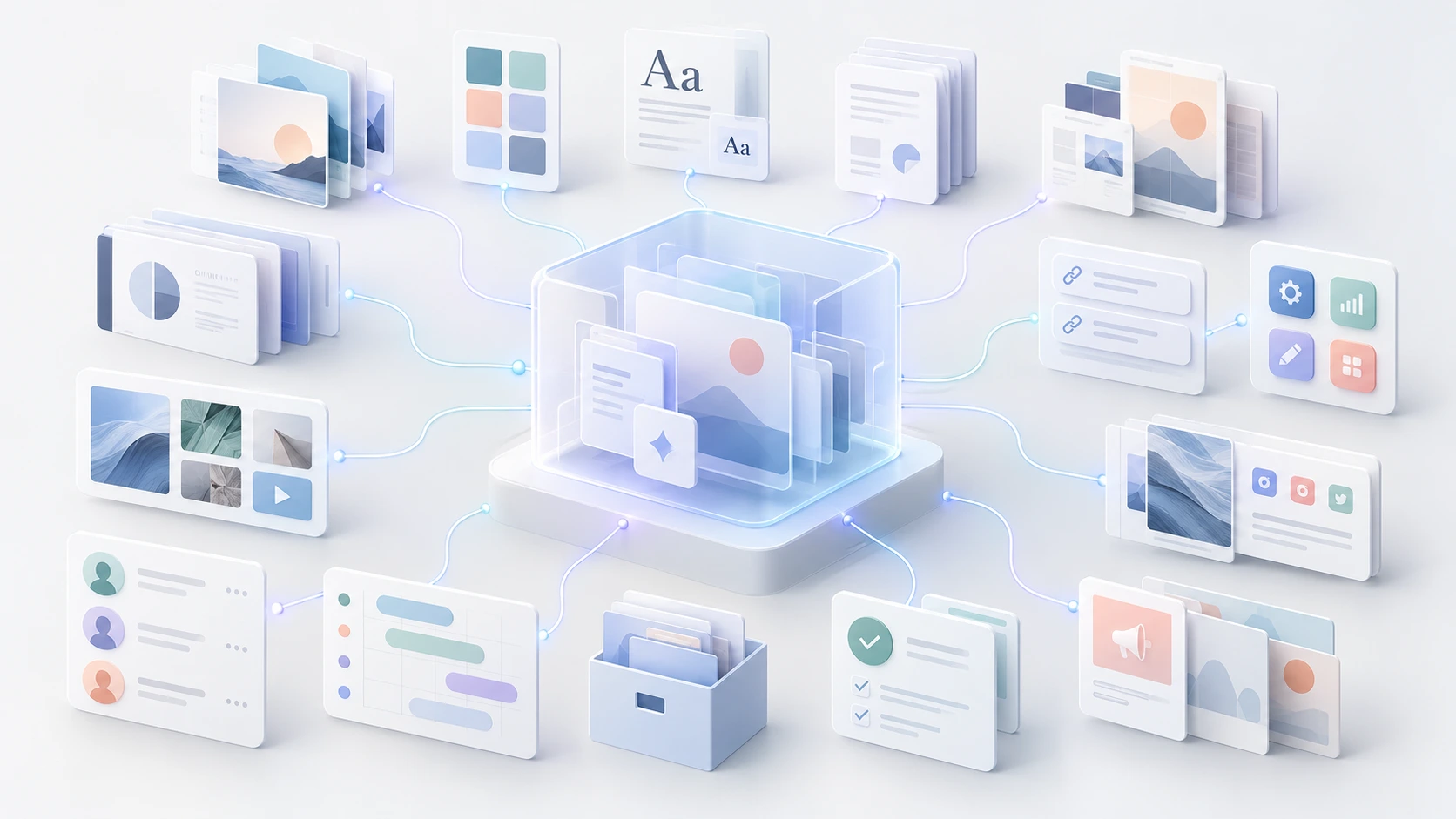
10. Create One Place for Your Team to Start
Perhaps the most important improvement is giving your team a clear starting point.
Your employees shouldn't have to remember which application contains every piece of information.
Instead, give them a central workspace where they can start with the client, project, or brand and quickly access the resources connected to it.
For agencies, this could look like:
Client → Brand → Assets → Documents → Projects → Tools
That simple structure can make a complex digital environment much easier to navigate.
Productivity Isn't Always About Doing More
Improving productivity doesn't necessarily mean making your team work faster.
It often means removing the things that shouldn't be taking their time in the first place.
Searching for files.
Repeating work.
Looking for information.
Attending unnecessary meetings.
Figuring out unclear processes.
Switching between disconnected tools.
These small inefficiencies can add up.
And when you remove them, your existing team can often handle more without immediately increasing headcount.
How Awolan Helps Teams Work More Efficiently
Awolan is designed for teams and agencies managing multiple client brands.
Instead of keeping each client's brand resources scattered across different folders, tools, and conversations, Awolan gives your team a centralized workspace for the brand assets, documents, links, and digital tools they need.
Your team can start with the client brand and find the resources connected to it.
Less searching.
Less switching.
Less asking where something is.
More time for the work that actually matters.